

ACRO member companies have compiled a series of case studies that demonstrate how centralized monitoring identifies critical issues more quickly and effectively than traditional on-site monitoring methods. This is the second post in a series highlighting centralized monitoring at work. Check back for more examples of how centralized monitoring has benefited ACRO member companies and their sponsor partners.
Case Study 1: Detection of eDiary Compliance in Vaccine Trial
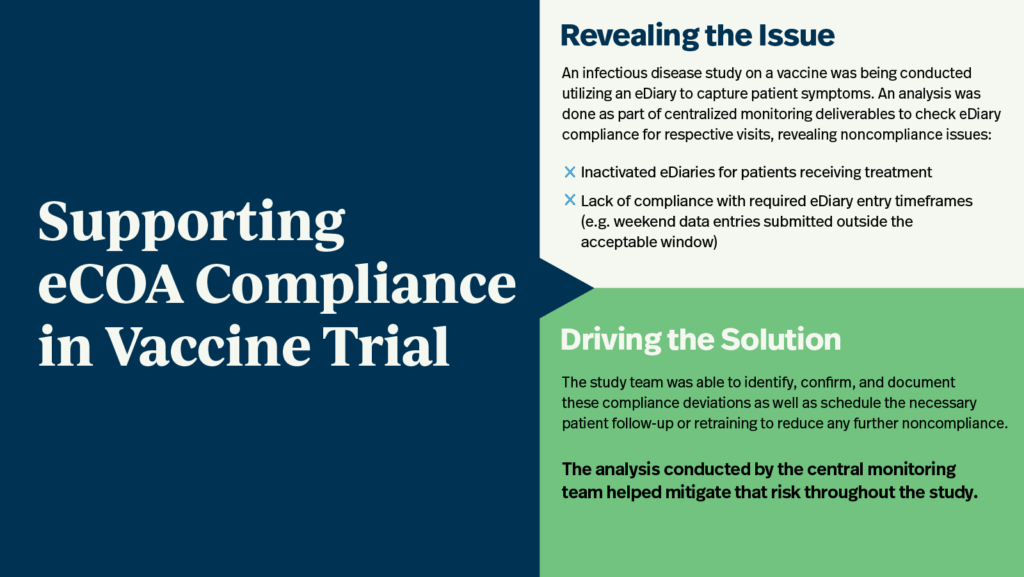
This case study of a vaccine trial highlights the pivotal role that centralized monitoring plays in improving compliance with the Electronic Clinical Outcome Assessment (eCOA). An infectious disease study on a vaccine was being conducted utilizing an electronic patient diary (eDiary) to capture patient symptoms. As a component of eCOA employed in this study, the Asthma Control Questionnaire (ACQ) and St. George’s Respiratory Questionnaire (SGRQ) were used to assess asthma control and its impact on a patient’s quality of life. Patient completion of the eDiary had been identified as a critical process during the risk assessment in its capacity to capture adverse effects (AEs) on a regular basis. An analysis was conducted as part of centralized monitoring deliverables to check for eDiary compliance during respective visits as per the protocol, revealing a number of noncompliant patients. Among the noncompliance issues were:
- Inactivated eDiaries for patients receiving treatment
- Lack of compliance with required eDiary entry timeframes (e.g., weekend data entries were being submitted when data entries were expected during the weekday on the same day as each visit)
As a result of the analysis, the study team was able to identify, confirm, and document the presence of these compliance deviations at a critical time point ensuring early intervention and reducing the impact of potential non evaluable patients during trail analysis.
During the initial risk assessment, the team recognized that eDiary non-compliance could result in non-evaluable patients. This was factored in when developing the centralized monitoring plan, and the analysis carried out by the central monitoring team enabled the team to mitigate the risk remotely without having to send a CRA to the site solely for this issue.
Case Study 2: eDiary Data Review Exposes Need for Clarification
A recent Phase III General Medicine study illustrates how centralized monitoring can be used to identify unreported adverse events (AEs) and to improve data quality and protect patient safety at sites. In this study, it was discovered through centralized monitoring that AEs (bleeding and cramping) that were being recorded by patients in the eDiary were not being entered into the Electronic Data Capture (EDC) system as required per the protocol. This misunderstanding of the protocol by the sites led to protocol deviations resulting in mass under-reporting of AEs. Further analysis concluded that the entry guidelines for patients and subsequently site staff were not being followed correctly, despite site initiation visit training for sites, and documented patient education by the study coordinators.

As a result of the centralized monitoring finding, sites that were underreporting AEs were identified and improvement actions were implemented to ensure safety events were being properly reported. Site-level improvements included the issuance of a protocol clarification letter to the affected sites, and all other sites to proactively address the issue. After the letter went out, the sponsor and CRO conducted an all-site training call to address the issues and discuss the clarification letter in detail to make sure all site staff was aligned going forward.
Ultimately, the central monitor identified 72% of total protocol deviations (PDs) in the study, including 76% of important PDs. The average time between PD occurrence and identification was 20 days faster for PDs identified by the central monitor vs. those identified by the clinical research associate (CRA).
The enhanced oversight from central monitoring ensured a more precise AE capture rate on the study, improving data accuracy. Monitoring visits were scheduled in 10-week intervals, so this may not have been detected for another 10 weeks had it not been for centralized monitoring. This issue was not identified through data management reconciliation or onsite monitoring by CRAs, and if it continued undetected, it could have resulted in delayed interim analysis or invalidation of study results.