

ACRO member companies have compiled a series of case studies that demonstrate how centralized monitoring identifies critical issues more quickly and effectively than traditional on-site monitoring methods. This is the fourth post in a series highlighting centralized monitoring at work. Check back for more examples of how centralized monitoring has benefited ACRO member companies and their sponsor partners.
Case Study 5: Centralized Monitoring Finds and Remediates Vital Sign Measurement Misalignment
A recent global Phase III Oncology study illustrates how centralized monitoring can be used to detect data integrity issues. In this instance, a data surveillance plan including key risk indicators, centralized statistical monitoring, and quality tolerance limits was developed as part of a centralized monitoring strategy.
The surveillance plan, with a focus on vital sign compliance, rounding, duplication, and potential propagation, identified a site outlier for 95% of values rounded with more than seven consecutive duplicate values. Upon discovery, the findings were escalated to the central monitor, who triaged it as suspected scientific misconduct and quickly reported it to the sponsor.
The central monitor subsequently requested a vital sign process evaluation and information on how the site collects body temperature. The clinical research associate (CRA) contacted the site to review procedures for any site performance issues. During a phone call with the project coordinator, the CRA evaluated site staff procedures for vital sign collection and learned that temperature was being measured “by touch” due to a misplaced oral thermometer. Unable to locate the thermometer, the site coordinator collected temperature “by touch,” unaware it was inadequate, and did not notify the principal investigator of the deviation from the defined process. As a result, the site coordinator documented numeric temperature data in both the patient records and the corresponding eCRF pages, despite not using an oral thermometer as required by the protocol.
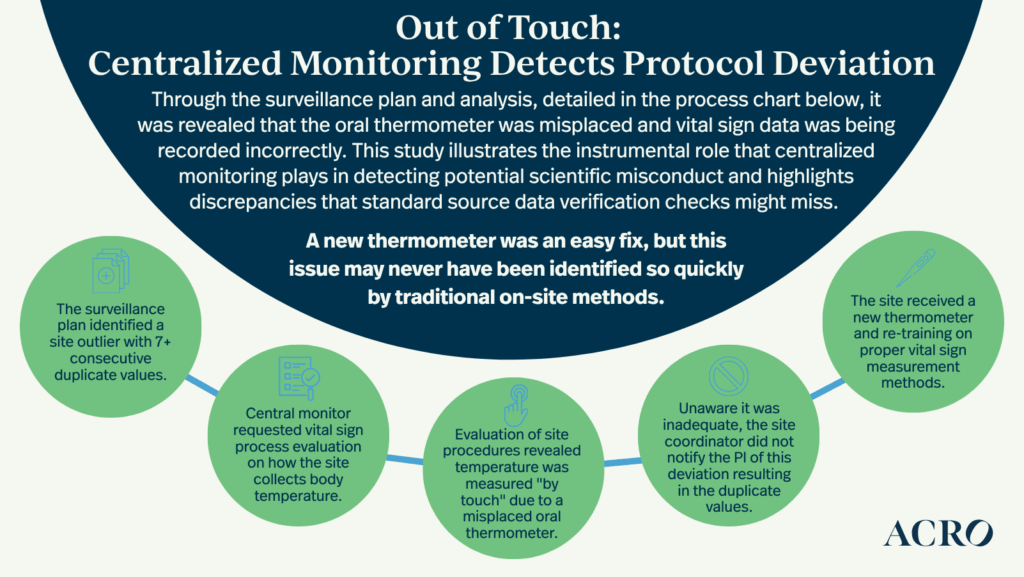
Ultimately, the investigation found no significant impact on endpoint data. The site received a new thermometer and re-training on proper vital sign measurement methods, ensuring future data integrity on this study and future studies. This case study illustrates the instrumental role that centralized monitoring plays in detecting potential scientific misconduct and highlights discrepancies that standard source data verification (SDV) checks might miss. A new thermometer was an easy fix, but this issue may never have been identified by a CRA using traditional on-site methods.
Read the additional case studies in the Centralized Monitoring at Work series: