

ACRO member companies have compiled a series of case studies that demonstrate how centralized monitoring identifies critical issues more quickly and effectively than traditional on-site monitoring methods. This is the fourth post in a series highlighting centralized monitoring at work. Check back for more examples of how centralized monitoring has benefited ACRO member companies and their sponsor partners.
A recent global Phase III infectious disease study illustrates how centralized monitoring can be used to detect data quality issues.
As part of a centralized monitoring strategy, the sponsor and CRO worked together to develop a data surveillance plan including key risk indicators (KRIs), centralized statistical monitoring, and quality tolerance limits (QTLs). The KRIs were 1) The proportion of participants missing at least half of their eDiary entries between Days 1 and 8 with the alert threshold set to 5%. 2) The proportion of participants with important protocol deviations (PDs) with the alert threshold set to 20%
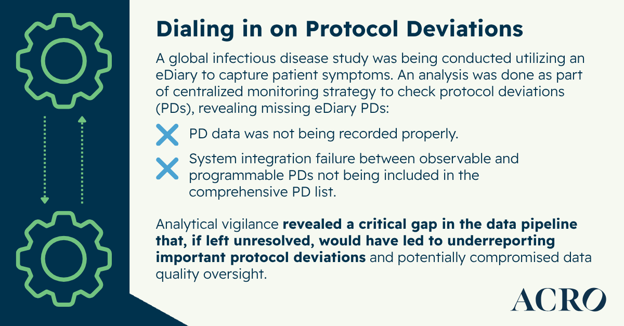
The surveillance plan identified that the number of participants missing 50% or more of their eDiary data for Days 1-8 was increasing over several reviews, while the number of participants with important PDs was not increasing in parallel. Centralized monitoring identified two related issues involving how PDs were being captured and integrated into a PD review system. First, some PD data was not being recorded properly. A review of patient-level data for important PDs found that some PDs related to eDiaries were not present in the source data, creating gaps in critical information. Second, there was a system integration failure that resulted in all observable and programmable PDs not being included in the comprehensive PD list.
It was discovered that eDiary-related PDs were not flowing from the source system into the PD Tool. Because one set of information was not successfully integrated, analysts conducting PD reviews did not have a complete list of PDs data available when setting up the KRIs. The data management team was promptly notified of the missing eDiary PDs and determined that IT intervention was required.
In this case, analytical vigilance revealed a critical gap in the data pipeline that, if left unresolved, would have resulted in underreporting important protocol deviations and potentially compromised data quality oversight.
Read the additional case studies in the Centralized Monitoring at Work series: