

ACRO member companies have compiled a series of case studies that demonstrate how centralized monitoring identifies critical issues more quickly and effectively than traditional on-site monitoring methods. This is the fourth post in a series highlighting centralized monitoring at work. Check back for more examples of how centralized monitoring has benefited ACRO member companies and their sponsor partners.
A recent global Phase II rheumatoid arthritis study illustrates how centralized monitoring can be used to detect protocol compliance issues.
A data surveillance plan including key risk indicators (KRIs), centralized statistical monitoring, and quality tolerance limits (QTLs) was developed as part of a centralized monitoring strategy. Critically, the project protocol required that the same assessor perform Tender and Swollen Joint Count and Physician Global Assessor assessments at each time point for each participant to measure overall disease activity and/or response to treatment.
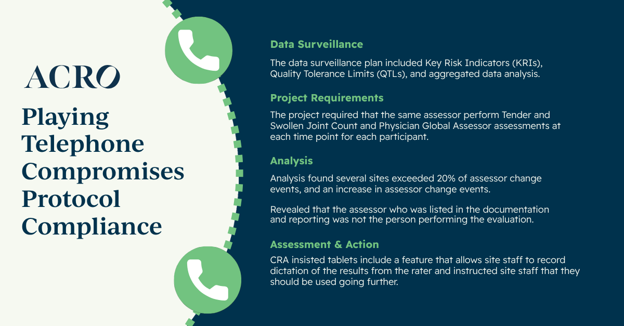
Upon analysis, centralized monitoring flagged several sites with KRIs above the high limit including a 20% of assessor change events and an increase in assessor change events across multiple sites. In response, the regional clinical operations leader investigated and found that study coordinator was entering the assessment from the endpoint data collection and management system within the tablet based on what the assessor dictated to him while performing the subject evaluation. It was clear from this investigation that the assessor that was listed in documentation and reporting was not the person performing the evaluation. To mitigate further protocol noncompliance, clinical research associates insisted that their tablets include the feature that allows site staff to record someone dictating the results from the rater and instructed site staff to use this function going forward.
The enhanced oversight from central monitoring ensured the integrity of efficacy data available for project analysis.
Read the additional case studies in the Centralized Monitoring at Work series: