

Centralized Monitoring as Best Practice
Risk-Based Quality Management (RBQM) in clinical trials centers on detecting, addressing, preventing, and mitigating risks that could undermine patient safety, trial processes, and data quality, enabling clinical operations teams to mitigate risks or address errors quickly and effectively before they compromise trial outcomes.
RBQM strategy involves the inclusion of several components depending on project needs including risk assessment, remote monitoring, key risk indicators (KRIs), and quality tolerance limits (QTLs), source data review (SDR) and source data verification (SDV). Centralized monitoring is increasingly accepted as a standard practice for a vast majority of studies.
ACRO’s own landscape data on RBQM adoption shows that the industry is trending in this direction to manage clinical trial data. To that end, centralized monitoring has the capacity to reduce monitoring costs by up to 20%1 through the reduction of SDR and SDV by offering a holistic and comprehensive view of trial data and enabling faster deviation identification. Notably, centralized monitoring should be applied based on the risk assessment as the data from these assessments underpin decision-making on the scope and scale of the centralized monitoring as well as extent to which SDR/SDV is needed.
Despite its potential to optimize clinical trials significantly, the industry has been slow to adopt centralized monitoring and shift away from traditional approaches like 100% SDR and SDV. In large or mega-sized studies (defined as > 1,000 participants) started in 2024, 100% SDR was being used 82% of the time and 100% SDV was being used 30% of the time. These outdated practices are costing the industry time, capital, and human resources for little return.
Outdated practices are costing the industry time, capital, and human resources in exchange for little in return.
To better understand industry resistance to reducing levels of SDV and SDR, it is critical to examine the differences between the two methods. Though SDV and SDR can be effectively applied together, project teams often assume that they should always be applied as a package. However, they have two very different roles to play.
SDV—the comparison of original source data to case report form data—is about identifying transcription errors. It checks the accuracy of a data point per the source records. Increasing SDV would be a rare mitigating action if a project is experiencing site performance issues/risks. SDV is limited in scope; it can neither detect errors introduced upstream (e.g., incorrect data collection, protocol misinterpretation, or incomplete documentation) nor can it identify systemic process issues, protocol deviations, or trends across sites and subjects.
In contrast, SDR compares source documents in relation to the overall clinical conduct and protocol adherence. This is a deeper, more holistic review, as the aim is not to evaluate a single data point but to evaluate that data point in context. SDR provides confidence that a site follows standard operating procedures, quality standards, and GCP compliance.
Association of Clinical Research Organizations (ACRO), 2025, RBQM Summary Report.
The stakes are high in a clinical trial, and companies that manage and run the trials, understandably, want to ensure they are not missing adverse events, data quality issues, or other problems that could impact the project or threaten patient safety. For example, concerned with missing adverse events, a project team may implement a 100% SDR/SDV strategy, with or without centralized monitoring. However, experience suggests that 100% SDR/SDV actually leaves more room for errors and additional opportunities for mistakes. It can also create logistical challenges for CROs and sponsors that cost valuable time and money.
Using a cornfield as a metaphor, if you ask your clinical research associates (CRAs) to double check every single kernel of corn in a cornfield (the equivalent of 100% SDR/SDV), it would be time consuming, expensive, and leaves room for error if the CRA misses a single kernel that may or may not represent an issue (a single data point). It is more efficient and effective to take a wide-angle and holistic view of the whole corn field (the equivalent of centralized monitoring) and send the CRAs to the rows of corn that are clearly not receiving enough sunshine, or to specific stalks of corn that you suspect may have mold infestation.
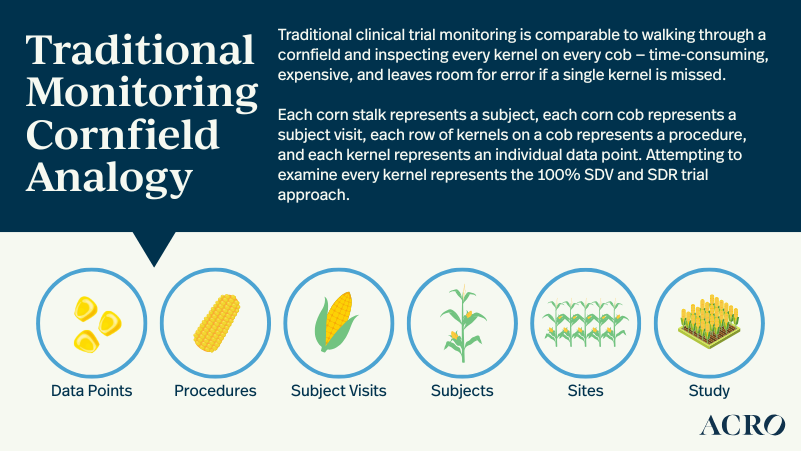
Reducing SDV and SDR does not mean less oversight. It means that we have better, smarter, and more optimized oversight, as time and resources are being focused on the sites or data trends that require more attention and support.
Another important consideration is how data is captured, entered, and stored. How is data being stored at sites, at the source, and in the medical record? Responses to these questions will impact how sampling is applied. Any sampling strategy begins with evaluation of the source data. That data is then compared to what has been entered into the system of record for analysis. In today’s trials, it is more often the case that critical data is captured outside of Electronic Data Capture (EDC). Meaning that critical data would not be eligible for a transcription check (SDV), but it would be reviewed (SDR) as part of the full patient data package.
Primer on Sampling Strategies
In deploying centralized monitoring, there are several sampling strategies that may be utilized depending on the type and size of the clinical trial. Centralized monitoring enables the use of flexible and adaptive SDV/SDR sampling strategies tailored to the study’s type, size, and operational complexity.
- Data Point Level: This strategy involves selecting a representative subset of data from the entire dataset to analyze, ensuring the sample accurately reflects the characteristics of the larger population.
- Procedure Level: Rather than selecting individual participants, procedure-level sampling is the selection of specific procedures or treatments to be investigated within a project. This strategy reviews the whole procedure from start to end using the lowest level of sampling as the data point.
- Visit Level: Visit Level sampling focuses the use of source data verification (SDV) and source data review (SDR) on select visits that have an abundance of critical data and processes within it to establish a clear start and end point (i.e. beginning of the visit, end to the visit).
- Subject Level: Subject-level sampling takes a holistic review of a whole subject record sampled from a group of subjects at a site. This strategy is best used when enrolling many subjects at a site, as it allows for the evaluation of a single subject that can then be used to extrapolate what might be present in all the other subjects enrolled at that site. For example, this approach is often used in vaccine studies, where they may be enrolling hundreds of subjects at a at a single location.
- Combination Strategy: Each organization will select one to two of these strategies. Most organizations will not opt to use all of these strategies, resulting in variety across the industry.
It is important to select the strategy that best serves the conditions of the project. Here are a few questions and considerations to help guide the decision-making process of what sampling strategy to utilize
- What is the best approach based on phase, indication, and/or patient population? (i.e., rare disease and/or vulnerable populations may warrant a higher rate of SDR).
- What is going to deliver the best quality?
- How do we ensure confidence in the data collected?
- How can we be most efficient with data collection?
Sponsors and CROs sometimes unintentionally design a sampling model utilizing highly complex strategies that do not always necessarily improve quality. These strategies can even run the risk of non-compliance if the strategy does not align with available technologies. It is essential to note that the FDA guidance2 has indicated that sampling of critical data points of subject and study visits should be sufficient. Similarly, ICH E6(R3) emphasizes a risk-proportionate approach3, which is in line with a strategic sampling strategy.
The FDA and other regulators are appropriately not interested in small, inconsequential errors. Rather, the regulators are more concerned with systemic, repetitive errors that have the capacity to disrupt the quality of the overall data integrity of the project.
Benefits of Centralized Monitoring with SDR and SDV Sampling
For any sampling method selected, the most effective and efficient monitoring strategy is centralized monitoring paired with a sampling of SDR and SDV. Centralized monitoring with its swift identification of data discrepancies, errors, or deviations from the protocol, combined with holistic, context-based SDR, focuses resources strategically, allowing for meaningful cost reductions while maintaining—or even enhancing—data quality and regulatory compliance. Centralized monitoring with SDR not only benefits CROs, allowing for greater strategic oversight, but also sponsors. Sponsors can expect more predictable timelines, reduced monitoring costs, and greater confidence in data quality.
Furthermore, though selecting a robust sampling strategy that fits the needs of a project is critical, the bottom line is that regulators are most concerned about systematic failures to protect data or the patients in a trial. When findings are raised, the regulator looks back to see whether the sampling strategy and plan was followed correctly or not. The practical application of the strategy chosen must be documented from the view of what will be done (patient vs. visit, etc.) as well as from the view of what was done (completion tracking). It is the latter that often presents a bigger challenge. Regardless of the sampling strategy chosen, it is essential to establish and carry through the selected sampling plan and ensure documentation shows adherence to that plan unless, of course, quality issues necessitate a revision.
Footnotes
1Stansbury, Nicole. “7 Reasons to Ditch Traditional Monitoring in Favor of a Centralized Strategy.” Perspectives, Premier Research, 3 Jan. 2024, https://premier-research.com/perspectives/7-reasons-to-ditch-traditional-monitoring-in-favor-of-a-centralized-strategy/. Accessed 1 Oct. 2025.
2Food and Drug Administration. “Oversight of Clinical Investigations—A Risk-Based Approach to Monitoring.” Guidance for Industry. August (2013). https://www.fda.gov/media/116754/download
3International Council for Harmonisation of Technical Requirements for Pharmaceuticals for Human Use. “Guideline for Good Clinical Practice: E6 (R3)” Guideline. January (2025). https://database.ich.org/sites/default/files/ICH_E6%28R3%29_Step4_FinalGuideline_2025_0106.pdf